


Product Details
--- QUICK SPEC REFERENCE ---
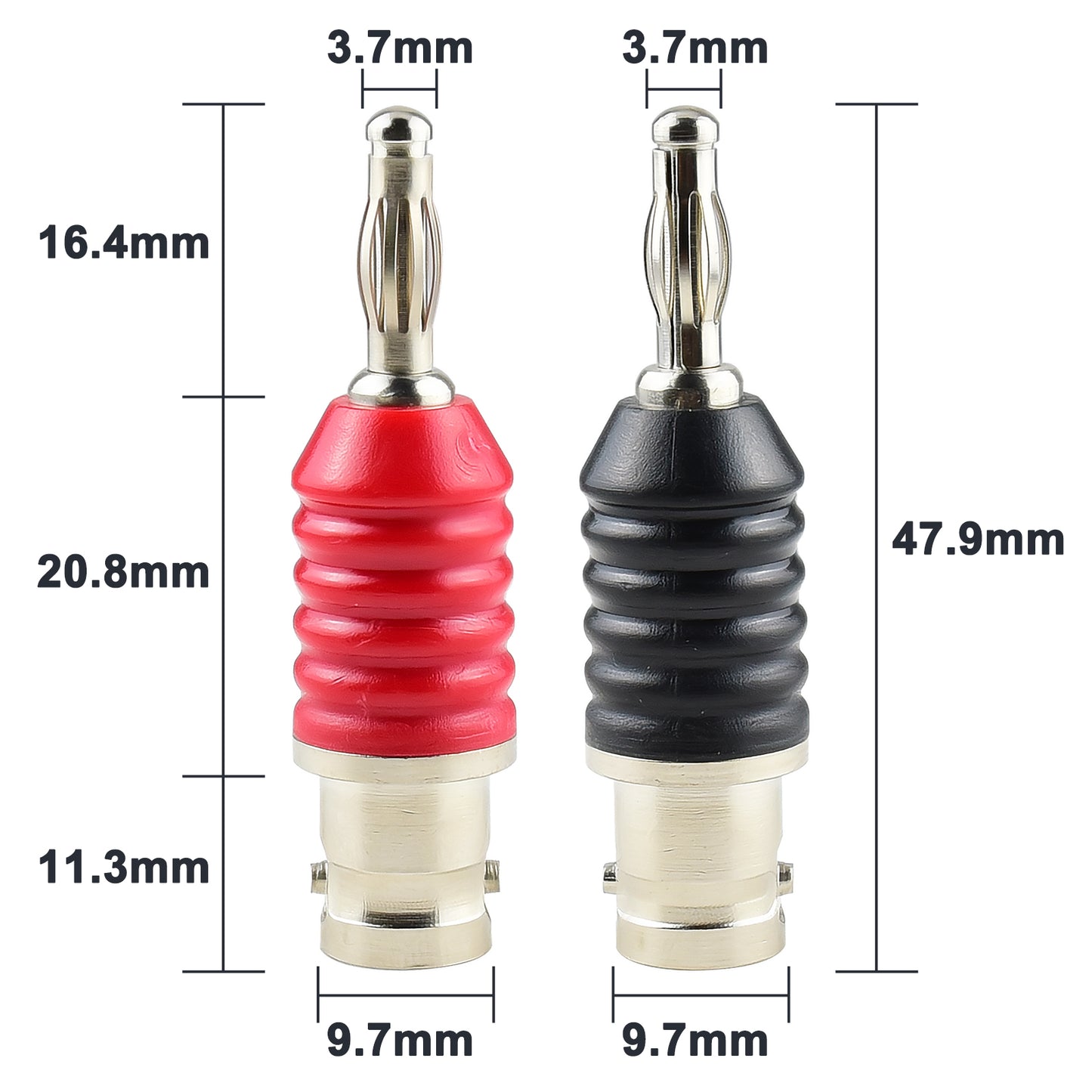
Product: BNC Female to 4mm Banana Plug (Male) Adapter
SKU: OL-6291-2X
Connector A: BNC Female (bayonet lock, center socket)
Connector B: Dual 4mm Banana Plug (Male, stackable)
Insulation: Insulated banana plugs
Spacing: 19mm (0.75 inch) standard
Applications: Oscilloscope, QRP rig, dipole antenna, signal generator binding post
Quantity: 2 adapters per pack
Price: $6.98
In Stock: Yes
---
This adapter converts a BNC female end into two insulated 4mm banana plugs, allowing a BNC-terminated cable or instrument port to connect to binding post terminals, banana jack sockets, and test fixture terminal blocks. The 19mm standard spacing matches the universal spacing used on oscilloscope channel inputs, function generator binding posts, power supply terminals, and most test equipment with banana jack connections. The banana plugs are stackable, allowing additional leads to be inserted into the back of each plug without disconnecting the primary connection.
Typical applications include plugging a BNC-terminated coaxial cable into a binding post terminal block or test fixture, connecting a BNC coaxial feedline to a banana-jack-equipped antenna tuner or RF load, terminating a BNC cable end at a QRP radio's banana plug antenna connection points, and adapting BNC oscilloscope probe cables to binding post measurement points in circuit analysis work.
The BNC female end accepts any BNC male plug — from coaxial cable terminations, oscilloscope probes, signal generator cables, and BNC patch cords. The stackable banana plugs allow additional test leads to be daisy-chained onto each connection point. This adapter is the complement to the BNC Male to Banana Jack adapter: use this version when you need to adapt a BNC male cable to banana plug outputs; use the male version when you need to plug an adapter directly into a BNC female equipment port.
Frequently Asked Questions
Stackable banana plugs have a socket in the back of the plug body that accepts another 4mm banana plug. This allows additional test leads or probes to be inserted into the same connection point without disconnecting the primary lead. For example, you can plug this adapter's banana plug into a binding post, and then insert an additional banana plug lead into the back of the adapter's plug to simultaneously connect two instruments to the same point — useful for measuring voltage while also feeding a signal to a second instrument.
The BNC female end (center socket, internal bayonet threads) accepts any standard BNC male plug. Connect your BNC coaxial cable's BNC male termination to this end with a quarter-turn clockwise rotation to lock. The two banana plugs then insert into binding post sockets or banana jack inputs on your test fixture or equipment. This adapter is designed for connecting BNC cables TO banana jack equipment, not the reverse.
Yes, with one consideration: most oscilloscope probes terminate in a BNC male plug. This adapter's BNC female end accepts that plug, and the banana plugs then insert into the QRP radio's banana jack antenna terminals. However, oscilloscope probes have high input impedance (typically 1 MΩ) and are designed for measurement, not as antenna terminations. For actual antenna connection (transmit or receive), use a proper 50 ohm coaxial feedline with appropriate connectors.
For receive and low-power applications up to approximately 100 MHz, banana plug connections provide adequate RF performance. At higher frequencies, the open banana plug geometry introduces capacitance and impedance discontinuities that increase signal loss and VSWR. For precision RF work above 100 MHz, coaxial connectors (BNC, SMA, N-type) maintained throughout the signal path are preferred. For HF monitoring, SDR applications, and QRP work below 30 MHz, this adapter performs acceptably.
19mm (0.75 inch) is the international standard center-to-center distance between dual banana plug conductors, defined in IEC 61010. This spacing is used universally on oscilloscopes, multimeters, function generators, and RF test equipment across all major manufacturers. Adapters, probe sets, and patch leads built to this standard are interchangeable. Non-standard spacing adapters exist but are not compatible with standard equipment binding posts.
Many test scenarios require the same BNC-to-banana conversion at two points simultaneously — for example, connecting two channels of a dual-channel oscilloscope to two different binding post test points. The 2-pack also provides a spare for a commonly used bench adapter that experiences frequent mating cycles. BNC bayonet connectors are rated for approximately 500 mating cycles, and having a replacement available prevents test bench downtime.