


Product Details
--- QUICK SPEC REFERENCE ---
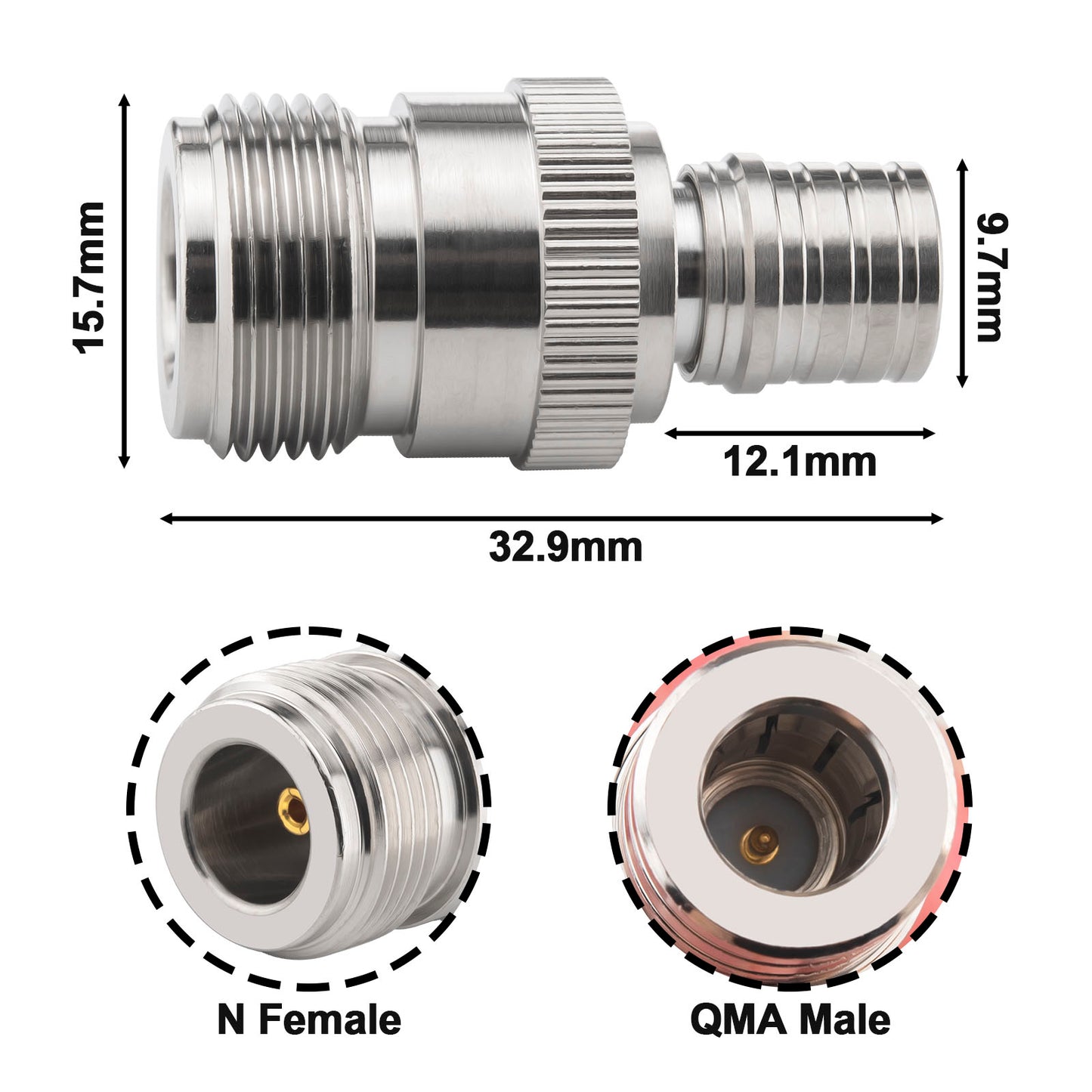
Product: N Female to QMA Male Adapter, DC-6GHz, IP54, 300W
SKU: OL-7148
Connector A: N Female
Connector B: QMA Male (push-pull lock)
Frequency Range: DC to 6 GHz
Insertion Loss: Less than 0.2 dB
IP Rating: IP54
Vibration Rating: 10g
Body Material: SUS304 Stainless Steel
Contact Material: Beryllium Copper
Power Rating: 300W
Connection Speed: Under 1 second (QMA push-lock)
Price: $11.99
In Stock: Yes
---
This adapter converts an N female port to a QMA male connector, enabling N-type antenna systems and feedlines to interface with QMA-port base stations, 5G small cell equipment, DAS (Distributed Antenna Systems), and commercial cellular infrastructure. QMA (Quick-lock Miniature A) is a push-pull locking connector that provides the electrical performance of SMA with connection and disconnection speeds under one second — approximately 10 times faster than threading an SMA connector — making it the preferred choice for high-density base station equipment where ports are frequently connected during installation, testing, and maintenance.
The SUS304 stainless steel body provides corrosion resistance exceeding standard nickel-plated brass for outdoor and harsh-environment base station applications. Beryllium copper contacts maintain the spring tension required for reliable QMA push-lock connection over 500+ mating cycles, and provide low contact resistance across the DC to 6 GHz operating range. IP54 rating indicates protection against dust ingress and water splashing from any direction — appropriate for outdoor base station enclosures and equipment cabinets with imperfect sealing. The 300W power rating accommodates commercial base station power levels.
QMA connectors are mechanically similar to SMA but use a push-lock outer coupling rather than threads. A QMA male plug is pushed straight into a QMA female port until it clicks into the locked position; pulling the outer sleeve back releases the lock for disconnection. QMA male and SMA male are NOT physically interchangeable — a QMA male will not thread into an SMA female port, and an SMA male will not push-lock into a QMA female port. This adapter provides the conversion between the two standards at the N-female side of an N-type antenna cable.
Frequently Asked Questions
QMA (Quick Miniature A connector, also sometimes called Quick-MA) is a push-pull locking RF connector with the same 50 ohm electrical geometry as SMA but with a snap-lock coupling mechanism instead of threading. It is used in 4G/LTE and 5G base station equipment, DAS (Distributed Antenna System) components, remote radio heads, and commercial wireless infrastructure where the speed of connection and disconnection matters during dense antenna array installation and field service. Major base station manufacturers including Ericsson, Nokia, and Huawei use QMA on some equipment lines.
Standard SMA requires 3–5 complete rotations to fully thread and engage — approximately 3–5 seconds per connection with a torque wrench. QMA requires a single straight push to lock — under 1 second. In a base station antenna array with dozens or hundreds of antenna ports, the time difference between SMA and QMA termination multiplies significantly. For a 64T64R massive MIMO antenna with 128 antenna connectors, the difference between SMA and QMA can represent hours of installation time at the system level.
IP54 indicates: "5" = dust protected (no harmful dust ingress, though not fully dust-tight), "4" = protected against water splashing from any direction. This rating is appropriate for outdoor base station equipment cabinets and enclosures that may be exposed to rain splash, condensation, and airborne dust. It is not suitable for submersion or sustained water jet exposure (which would require IP67 or IP68). For outdoor telecom installations, IP54 provides sufficient environmental protection for the adapter's service life in typical deployment conditions.
No. This adapter is rated to 6 GHz, which covers sub-6 GHz 5G NR bands (n71 at 600 MHz through n77/n78 at 3.5 GHz and n79 at 4.9 GHz). 5G mmWave bands (n257 at 28 GHz, n258 at 26 GHz, n260 at 39 GHz) require connectors rated to those frequencies — typically 2.92mm, 2.4mm, or 1.85mm precision connectors, not N-type or QMA. This adapter is appropriate for sub-6 GHz 5G NR infrastructure only.
Beryllium copper (BeCu) is a copper alloy with approximately 2% beryllium that provides exceptional spring properties — it maintains elastic deformation under repeated stress without permanently deforming (work hardening). In QMA push-lock connectors, the spring-loaded outer coupling sleeve must maintain consistent spring tension over hundreds of mating cycles. Beryllium copper retains its spring properties far better than phosphor bronze or standard brass under these conditions, ensuring reliable push-lock engagement throughout the connector's service life. BeCu also provides excellent electrical conductivity (approximately 22–25% IACS) for low-resistance signal paths.
Yes. The N female end of this adapter is a standard N-type female connector compatible with any standard N male plug. N-type is a precision 50 ohm connector with excellent dimensional consistency across manufacturers — any standard N male plug (from cable assemblies, test equipment, or antenna feedlines) will mate correctly with this adapter's N female end. The QMA male end is the specialized side; verify that your base station equipment uses QMA female ports before ordering.