


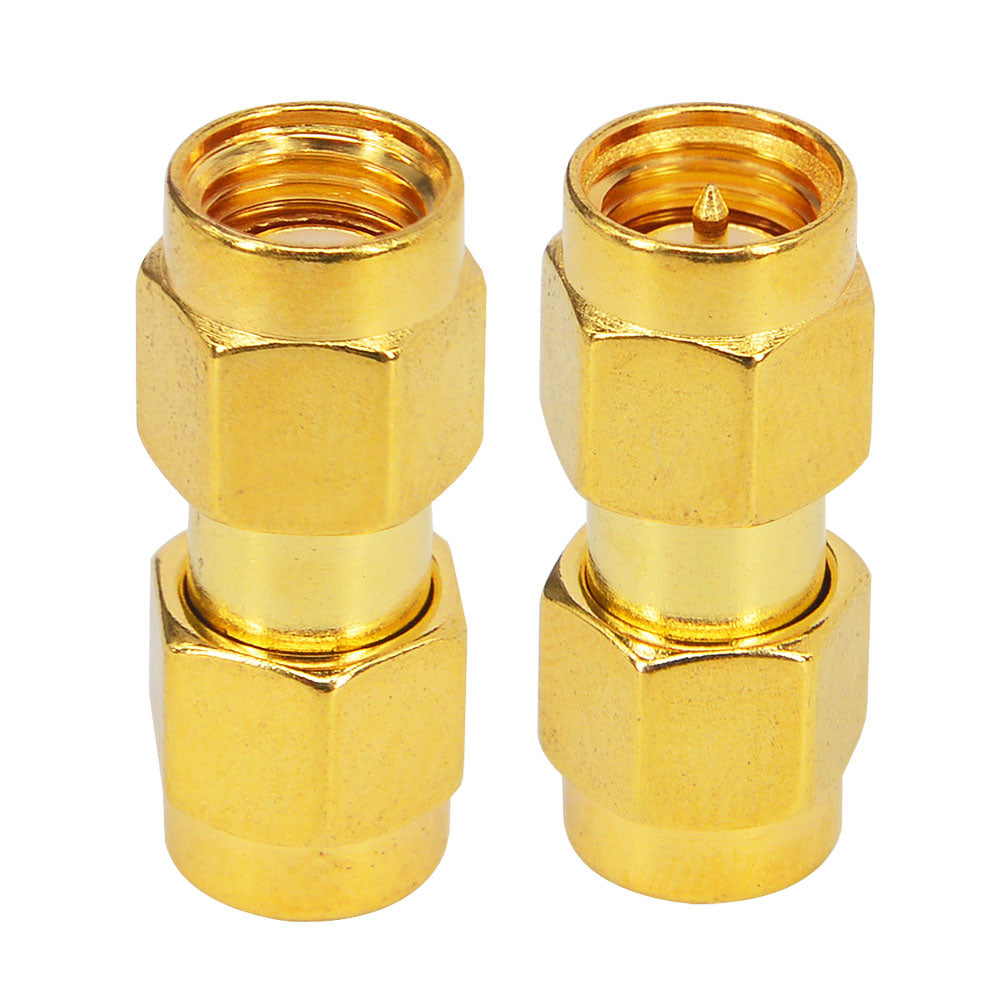
Product Details
--- QUICK SPEC REFERENCE ---
Product: SMA Male to RP-SMA Male Gender Changer Adapter
SKU: OL0842-2X
Connector A: SMA Male (standard — center pin)
Connector B: RP-SMA Male (reverse polarity — center hole)
Body Material: Brass, Gold Plated
Impedance: 50 Ohm
Applications: WiFi antenna extension cable, FPV drone, converting standard SMA to RP-SMA WiFi devices
Quantity: 2 adapters per pack
Price: $9.98
In Stock: Yes
---
This adapter converts a standard SMA male connector (center pin) to an RP-SMA male connector (center hole), enabling SMA-terminated cables and equipment to connect to RP-SMA female ports on WiFi routers, wireless access points, and FPV equipment. The fundamental difference between standard SMA and RP-SMA is the center conductor: standard SMA male has a protruding center pin, while RP-SMA male has a center hole (socket). Despite identical outer thread dimensions, these two standards are electrically incompatible without an adapter — the center conductor does not make contact when standard SMA is threaded into RP-SMA without one.
Common applications include connecting a standard SMA-terminated antenna extension cable to a WiFi router's RP-SMA female port; adapting SMA-terminated test equipment cables to RP-SMA-port WiFi access points for antenna pattern testing or signal analysis; converting the antenna connection on FPV equipment between SMA and RP-SMA standards; and enabling standard SMA pigtail cables to reach RP-SMA-port devices that are physically offset from the cable routing path.
This adapter has SMA male on one end and RP-SMA male on the other — both ends are male (plugs). It connects between two female ports: one SMA female and one RP-SMA female. This is a male-to-male gender changer, not a cable. For connecting an SMA male cable to an RP-SMA female device, this adapter inserts between the cable's SMA male plug and the device's RP-SMA female port. If your cable has an SMA female end and you need to reach an RP-SMA female port, a different adapter configuration is required.
Frequently Asked Questions
Standard SMA and RP-SMA have identical outer thread dimensions, so they will thread together mechanically. However, standard SMA male (center pin) inserted into RP-SMA female (also center pin) results in pin-to-pin contact — the two pins push against each other rather than making a socket-to-pin connection. Similarly, standard SMA female (center hole) on RP-SMA male (center hole) results in hole-to-hole with no center conductor contact at all. This adapter resolves the center conductor incompatibility by providing the appropriate male center connector on each side.
Yes, with a clarification about connection direction. Most WiFi routers have RP-SMA female ports (center pin visible in the port). This adapter has RP-SMA male on one end — which plugs into the router's RP-SMA female port — and standard SMA male on the other end. But standard SMA male needs to connect to an SMA female socket (on a cable or adapter), not directly to another SMA male. The typical use case: SMA-male-terminated pigtail cable → this adapter's SMA male end via SMA F-F coupler → adapter's RP-SMA male end → router's RP-SMA female port.
Quality brass adapters introduce approximately 0.1–0.2 dB of insertion loss at 2.4 GHz — negligible for practical WiFi applications. The conversion itself introduces no impedance mismatch since both SMA and RP-SMA are 50 ohm standards with identical electrical geometries (only the center conductor gender is different). Connection quality (proper thread engagement, clean contacts) has a far greater impact on signal integrity than the adapter's inherent insertion loss.
Yes. FPV video transmitters, receivers, and antennas use a mix of standard SMA and RP-SMA connectors depending on manufacturer and application. Long-range FPV systems often use standard SMA; shorter-range systems and many ready-to-fly quads use RP-SMA. This adapter allows cross-connection between the two standards, enabling a standard SMA antenna to be used with an RP-SMA-port VTX or a standard SMA-port VTX to accept an RP-SMA antenna — without the need to change connectors on the antenna or transmitter.
Look into the center of the female antenna port on your router. If you see a small protruding pin in the center, it is RP-SMA female (center pin present). If you see a center hole with no pin, it is standard SMA female (center hole). Most consumer WiFi routers (ASUS, TP-Link, Netgear, Linksys) use RP-SMA female ports with a visible center pin. Ham radio handhelds and RF test equipment typically use standard SMA female with a center hole. This is the fastest way to determine which standard your device uses without consulting documentation.
WiFi routers and dual-band access points typically have two antenna ports — one for 2.4 GHz and one for 5 GHz (or two MIMO antennas per band). The 2-pack allows both ports to be adapted simultaneously, maintaining a matched antenna configuration on both ports. Using mismatched adapters (one ported with adapter, one without) can create asymmetric antenna performance. A spare is also useful since male-to-male adapters at frequently connected points experience regular mating cycles.