


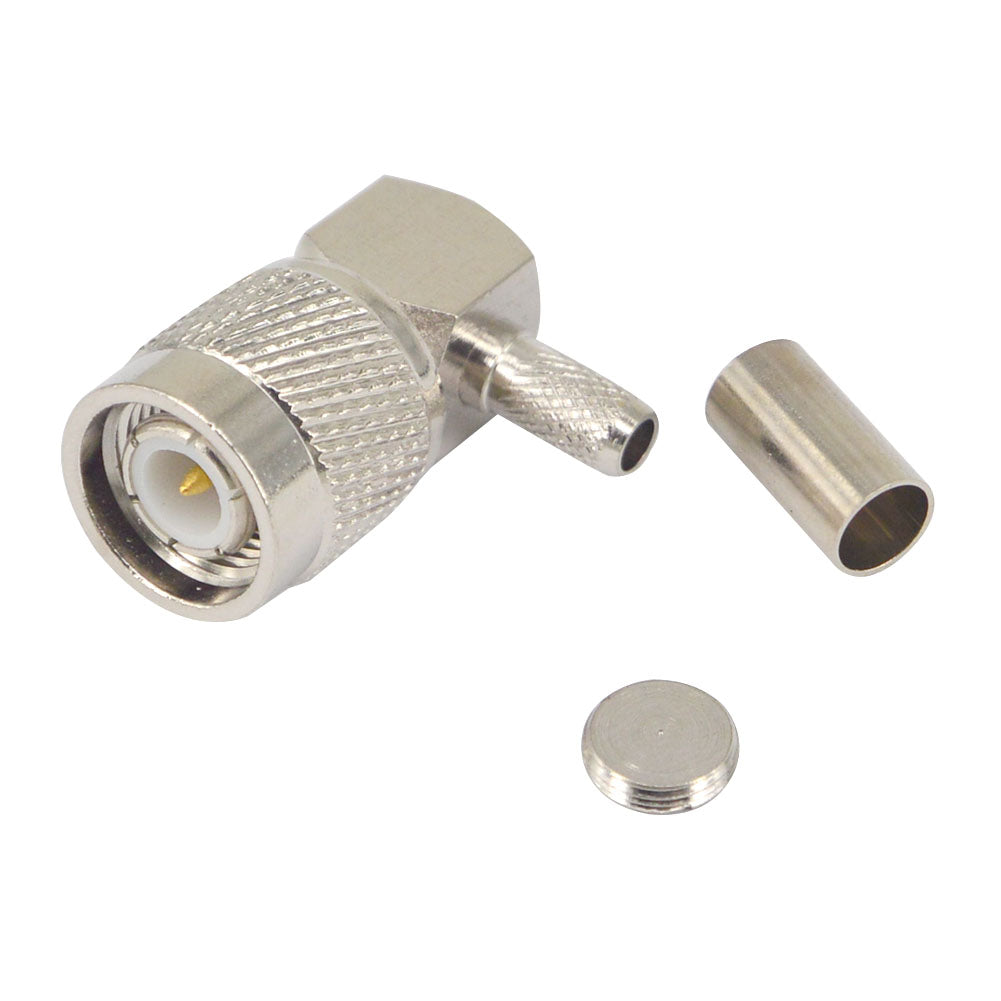
Product Details
--- QUICK SPEC REFERENCE ---
Product: TNC Male Plug 90 Degree Right Angle Crimp Connector
SKU: OL-3922-5X
Connector Type: TNC Male, 90 Degree Right Angle
Termination: Crimp (center pin: solder)
Body Material: Brass, Nickel Plated
Center Pin: Gold Plated
Frequency Range: DC to 3 GHz
Impedance: 50 Ohm
Compatible Cables: RG58, RG142, RG400, LMR195
Quantity: 5 connectors per pack
Price: $11.68
In Stock: Yes
---
This 90-degree right angle TNC male crimp connector allows a coaxial cable to exit perpendicular to the TNC port on an antenna, instrument, or radio, enabling cable routing along panels or enclosure surfaces without sharp cable bends. TNC connectors are preferred over BNC in applications requiring vibration resistance and reliable connection at frequencies up to 11 GHz — the threaded coupling nut prevents accidental disconnection under vibration that can disengage a BNC bayonet lock. The right angle body extends this advantage to installations where straight connectors would protrude awkwardly or stress the cable at the connection point.
Compatible with RG58, RG142, RG400, and LMR195 coaxial cables — medium-diameter cables with outer dimensions appropriate for this connector's crimp ferrule. The nickel-plated brass body provides corrosion resistance for both indoor and outdoor applications, and the gold-plated center pin maintains low contact resistance across the connector's service life. At DC to 3 GHz, this connector covers GPS (1575 MHz), cellular (700–2700 MHz), WiFi (2.4 GHz), and all standard VHF/UHF applications.
Installation requires a coaxial crimping tool with appropriate hex dies for the cable's outer conductor diameter. The center pin is solder-type despite the crimp outer ferrule — the center conductor of the coaxial cable must be soldered to the center pin before the outer ferrule is crimped. This hybrid crimp/solder construction is common on TNC right angle connectors. Verify cable compatibility (OD approximately 5mm for RG58/LMR195) before ordering.
Frequently Asked Questions
A right angle TNC connector is used when the cable needs to exit parallel to the mounting surface rather than projecting straight out. Common scenarios: panel-mounted equipment where the cable must route along the rear panel immediately after the connection; enclosures where a straight connector would protrude too far; and installations where the cable must make a 90-degree turn close to the connector — using an adapter instead of bending the cable prevents damage to the cable's dielectric and maintains impedance integrity at the bend point.
This connector is sized for medium-diameter coaxial cables with approximately 5mm outer diameter — RG58 (4.95mm OD), RG142 (4.95mm OD), RG400 (4.95mm OD), and LMR195 (4.95mm OD). These four cables have nearly identical outer dimensions, making them interchangeable in this connector. RG174 (2.8mm OD) and RG316 (2.5mm OD) are too thin; LMR400 and RG213 (10mm OD) are too large. Verify your cable's outer diameter before ordering.
Electrically, TNC and BNC are equivalent at GPS frequencies (1575 MHz for L1, 1227 MHz for L2) — both maintain good impedance characteristics well below 3 GHz. The advantage of TNC is mechanical: the threaded coupling prevents the connector from working loose under vibration, which is important for vehicle-mounted GPS antennas and field survey equipment that experiences motion during operation. BNC's bayonet lock can disengage under sustained vibration, causing intermittent signal loss. TNC is the standard for professional GPS/GNSS survey equipment for this reason.
You need a coaxial cable stripper calibrated for the specific cable dimensions (strip lengths vary by cable and connector), a fine-tipped soldering iron (0.8–1mm tip) for soldering the center pin, and a coaxial crimping tool with a hex die matched to the connector's outer ferrule diameter (typically 0.213" / 5.4mm hex for RG58-sized cables). The hybrid crimp/solder process requires both tools — solder the center pin first, then crimp the outer ferrule. Attempting to crimp without soldering the center pin will result in an unreliable center conductor connection.
Yes. The DC to 3 GHz rating covers 2.4 GHz WiFi. However, most consumer WiFi equipment uses SMA or RP-SMA connectors rather than TNC. TNC at 2.4 GHz is more commonly found on commercial and professional WiFi access points (some Cisco Aironet models use TNC), outdoor WiFi bridges, and military/industrial wireless equipment. If your WiFi equipment has TNC ports and you need right angle cable terminations, this connector is appropriate.
A cable assembly requires one connector at each end — a 5-pack covers two complete assemblies with one spare. Right angle connectors are more complex to install than straight connectors due to the angular geometry, and installation errors (misaligned crimp, cold solder joint on center pin) may require cutting off the connector and starting over. Having spare connectors prevents project delays from failed terminations.