


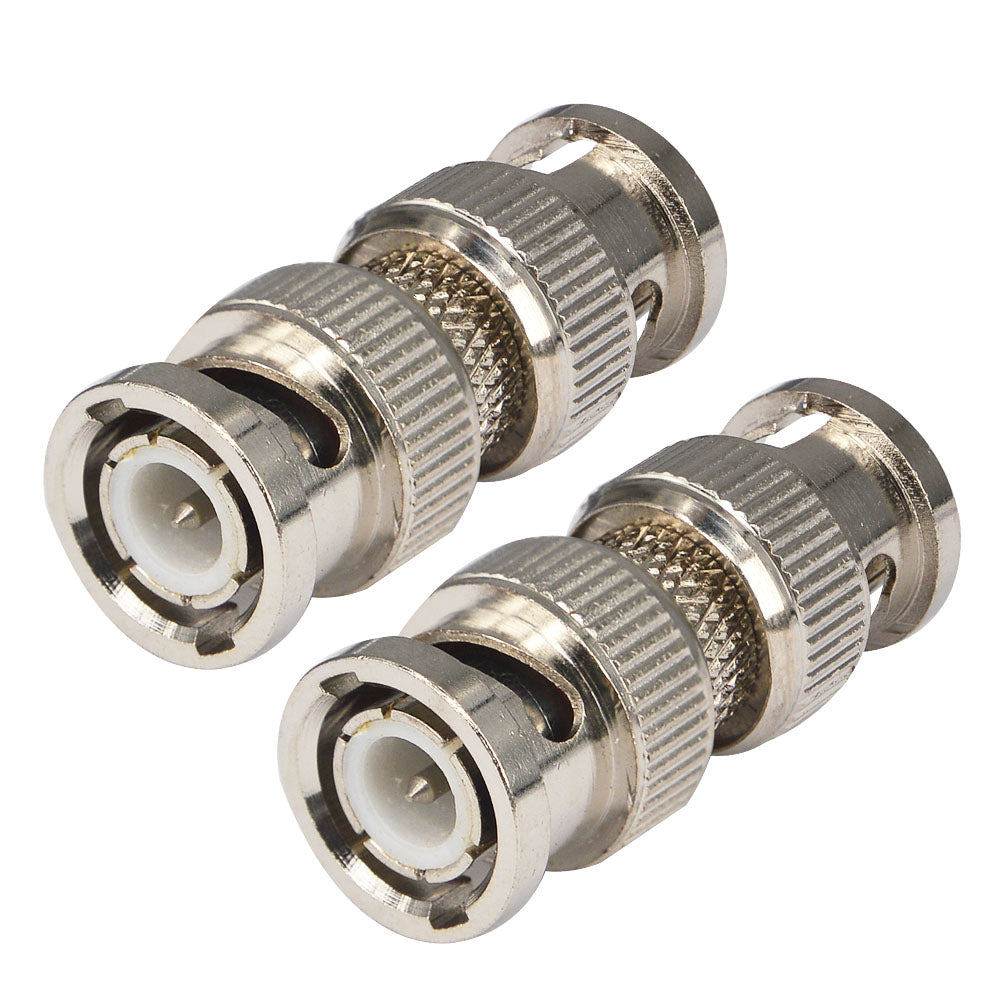
Product Details
--- QUICK SPEC REFERENCE ---
Product: BNC Male to Male Coupler (Gender Changer), 50 Ohm, Pack of 2
SKU: OL0045-2X
Connector A: BNC Male (bayonet lock, center pin)
Connector B: BNC Male (bayonet lock, center pin)
Body: Copper, Nickel Plated
Impedance: 50 Ohm
Applications: CCTV, DVR, security camera, joining two BNC female ports
Price: $5.99
In Stock: Yes
---
This BNC male-to-male adapter (also called a BNC gender changer or BNC barrel) joins two BNC female ports directly — plugging into both simultaneously to create a male-to-male bridge between two female connectors. This is needed when two pieces of equipment each have BNC female ports that need to be connected without a cable between them, or when a BNC-female-terminated cable needs to connect to another BNC-female-terminated cable end-to-end. Common applications include connecting two BNC female patch cable ends in a CCTV or DVR installation, bridging two BNC female test fixture ports on a signal analyzer bench, and extending CCTV camera cable runs where both cable ends terminate in BNC female connectors.
The copper body with nickel plating provides RF conductivity appropriate for the video frequencies used in CCTV and DVR applications (typically DC to 300 MHz for analog video, up to approximately 3 GHz for HD-SDI digital video). The bayonet locking mechanism on both ends ensures secure connections that resist accidental disconnection during normal handling of CCTV equipment. At 50 ohm impedance, this adapter is designed for RF signal applications — note that most CCTV video systems use 75 ohm impedance, and a 50-to-75 ohm mismatch may cause minor reflections in video systems, though in practice the effect is barely perceptible in short adapter connections.
This is a BNC male-to-male adapter — it has two BNC male plugs and connects between two BNC female ports. Do not confuse with a BNC female-to-female barrel (coupler), which has two BNC female ends and connects between two BNC male cable plugs. Verify which gender your specific application requires before ordering.
Frequently Asked Questions
You need a BNC male-to-male adapter when you have two BNC female ports that need to be directly connected — for example, connecting the BNC female output of one piece of test equipment to the BNC female input of another without any cable between them, or joining two BNC-female-terminated cable ends. If your cables have BNC male plugs and you need to join them, you need the opposite — a BNC female-to-female barrel coupler. Male-to-male connects two female ports; female-to-female connects two male plugs.
For analog CCTV video (DC to 10 MHz for standard definition), the insertion loss through a quality BNC adapter is negligible — well under 0.1 dB. For HD-SDI digital CCTV (3G-SDI at 2.97 Gbps carrier frequency approximately 1.5 GHz), quality matters more: the adapter should maintain 75 ohm impedance and low return loss at these frequencies. This adapter is rated at 50 ohm, which introduces a small impedance mismatch in 75 ohm CCTV systems. For short adapter connections in standard CCTV, this mismatch is imperceptible in practice.
This adapter is rated at 50 ohm. Most CCTV cameras, DVRs, and video distribution systems use 75 ohm impedance. The physical BNC connector is identical between 50 and 75 ohm versions — the difference is in the internal geometry of the connector body. For most analog CCTV applications, a 50 ohm adapter creates a negligible impedance mismatch over a short adapter connection. For critical professional video applications (broadcast, HD-SDI), purpose-built 75 ohm BNC adapters are the correct choice.
Yes, if both cable ends are terminated with BNC female connectors. However, directly joining two cable ends with a barrel adapter is generally less reliable than using a single continuous cable of the correct length. Every connection point introduces potential for signal loss and failure. For permanent CCTV installations, running a single continuous cable from camera to DVR is preferred where practical. Barrel adapters are appropriate for temporary connections, test setups, and situations where a continuous cable run is genuinely impractical.
A gender changer is an adapter with the same connector type on both ends but opposite genders — male-to-male or female-to-female. The name comes from the fact that it "changes" the gender of a connection, allowing a female port to connect to another female port (via male-to-male adapter) or a male plug to connect to another male plug (via female-to-female adapter). Gender changers are common in RF work because equipment is designed with specific connector genders that sometimes create male-to-male or female-to-female interface situations requiring an adapter.
CCTV and DVR systems commonly have multiple camera inputs and outputs, and the same gender conversion may be needed at multiple points simultaneously. The 2-pack covers two simultaneous installations or provides a spare for a bench application. BNC adapters at frequently connected test points experience regular mating cycles, and having a replacement available prevents test bench downtime when the primary adapter shows wear.