


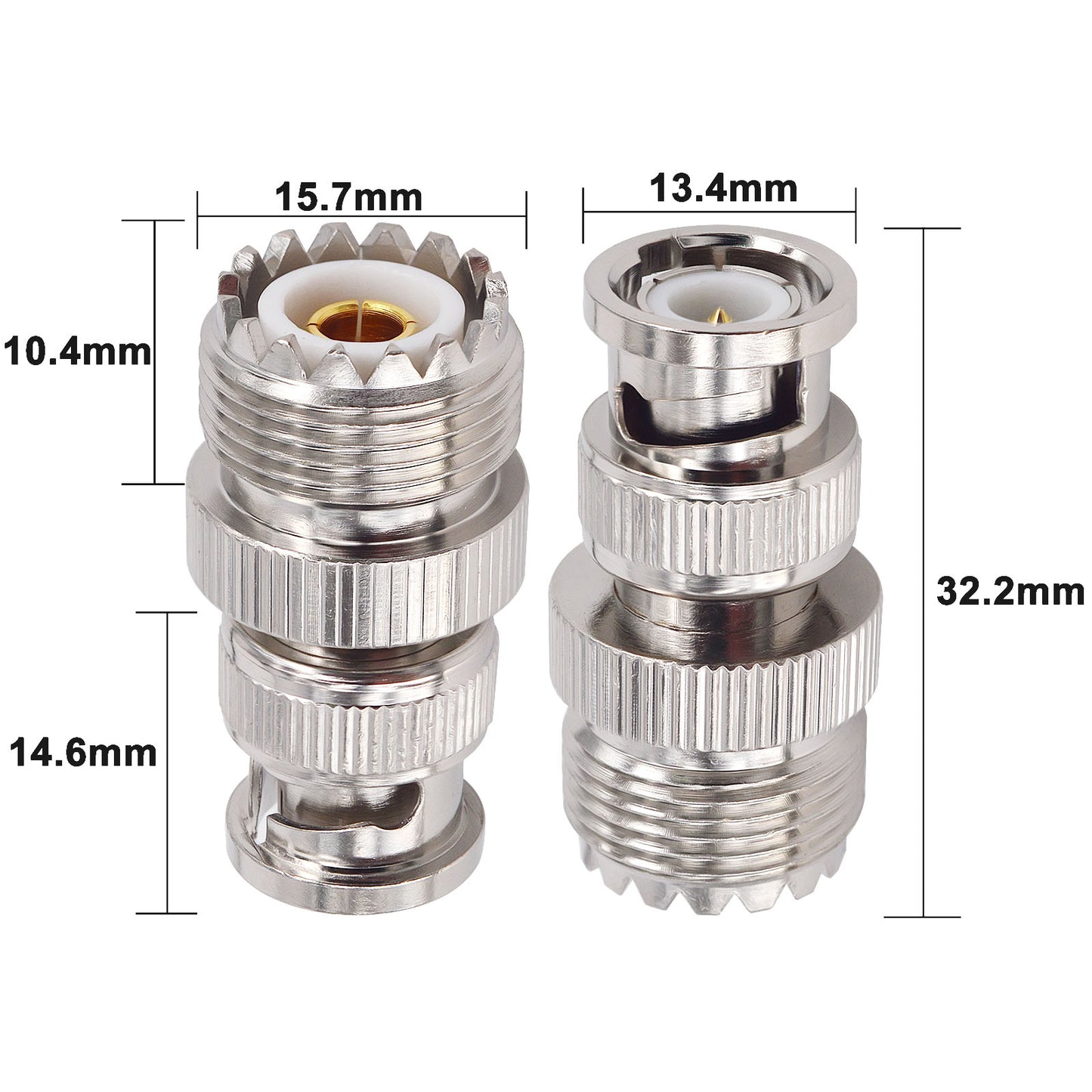
Product Details
--- QUICK SPEC REFERENCE ---
Product: BNC Male to UHF Female (SO-239) Coax Adapter
SKU: OL0834-2X
Connector A: BNC Male (bayonet lock, center pin)
Connector B: UHF Female / SO-239 (internal threads, center socket)
Body Material: Brass, Nickel Plated
Impedance: 50 Ohm
Quantity: 2 adapters per pack
Price: $10.99
In Stock: Yes
Compatible With: CB antenna, CB radio base stations with SO-239 ports; BNC-terminated test cables and signal generators
---
This adapter converts a BNC male connector to a UHF female (SO-239) port, allowing BNC-terminated cables, signal generators, and test equipment to connect to CB radios, HF transceivers, antenna tuners, and SWR meters that use the SO-239 (UHF female) standard. The BNC bayonet lock provides a quick quarter-turn connection, while the SO-239 end accepts any standard PL-259 (UHF male) plug from antenna cables or coaxial feedlines.
Pure brass construction with nickel plating provides corrosion resistance suitable for both bench and field use. The 50 ohm impedance is consistent with the UHF connector standard used in CB and amateur radio equipment. This adapter is particularly useful for connecting BNC-port oscilloscopes, spectrum analyzers, or signal generators to SO-239-equipped antennas and radio equipment during testing and alignment work, without needing to re-terminate cables.
Note on the UHF connector name: despite being called "UHF," the SO-239/PL-259 connector family is most commonly used at HF and VHF frequencies (1–300 MHz). It does not maintain constant 50 ohm impedance above approximately 300 MHz, so this adapter is best suited for CB (27 MHz), HF amateur radio (1–30 MHz), and VHF applications (30–300 MHz). For UHF frequencies proper (300 MHz and above), N-type or BNC connectors are preferred for better impedance control.
Frequently Asked Questions
SO-239 is the UHF female connector — a threaded socket that accepts the PL-259 (UHF male) plug. It is the standard antenna connector on CB radios, HF amateur radio transceivers, antenna tuners, SWR meters, and many VHF/UHF base station radios. The SO-239 has been the dominant connector in these applications since the 1930s due to its robust mechanical construction and ease of field assembly.
Yes. Most RF signal generators use BNC female output ports. This adapter's BNC male end connects to the signal generator's BNC female port, and the SO-239 end connects to the CB antenna feedline's PL-259 plug. This allows you to inject a test signal at CB frequencies (26.965–27.405 MHz) directly into the antenna system for alignment, SWR measurement, or propagation testing without modifying cables.
Yes, at CB power levels (up to 4W AM or 12W SSB for legal CB operation). The brass and nickel construction handles the power levels of standard CB and amateur radio HF operation without issues. For high-power amateur radio amplifier use (1kW+), purpose-built high-power adapters with heavier construction are more appropriate.
The SO-239/UHF connector standard does not maintain constant 50 ohm impedance above approximately 300 MHz due to its non-precision geometry. In practice, this adapter is suitable for DC through VHF (up to approximately 300 MHz). For UHF and microwave frequencies, N-type or SMA connectors provide better impedance control and lower VSWR. For CB (27 MHz) and HF/VHF amateur radio use, this adapter performs without meaningful signal degradation.
Yes. The BNC bayonet lock engages with a quarter-turn rotation, providing a secure mechanical connection that resists accidental disconnection. The bayonet lock also allows rapid connection and disconnection — useful in bench testing scenarios where cables are frequently moved between test points. BNC connections are not weatherproof; for outdoor use, additional protection or a different connector type is recommended.
Having two adapters is practical for test bench setups where the same conversion is needed at multiple points simultaneously — for example, connecting both a signal generator and an oscilloscope to different points in the same antenna system. A spare is also useful since adapters at frequently-connected bench positions experience regular mating cycles and may eventually show wear.