


Product Details
--- QUICK SPEC REFERENCE ---
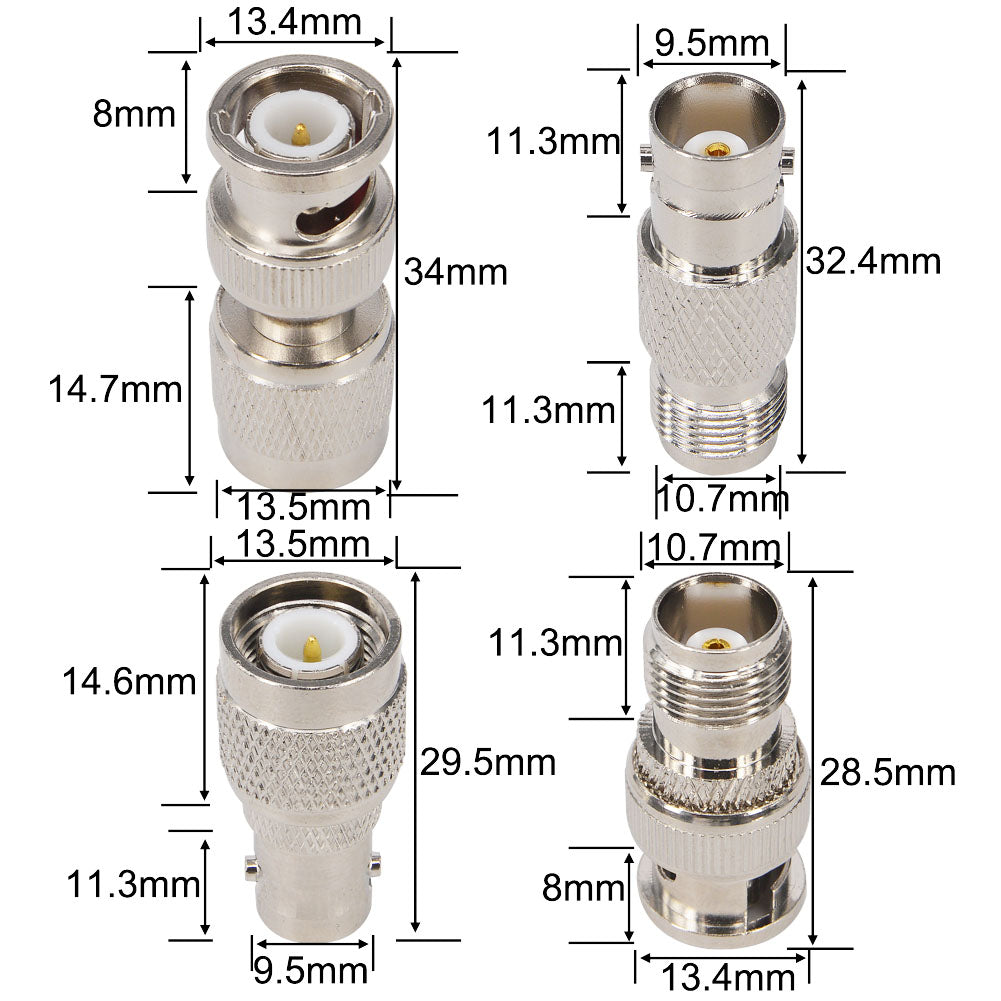
Product: 4-Piece BNC to TNC Adapter Kit (All Gender Combinations)
SKU: OL-4445
Kit Contents:
  1x BNC Male to TNC Male
  1x BNC Male to TNC Female
  1x BNC Female to TNC Male
  1x BNC Female to TNC Female
Impedance: 50 Ohm
Frequency Range: DC to 3 GHz (BNC), DC to 11 GHz (TNC)
NOTE: Standard TNC only — NOT RP-TNC
Quantity: 4 adapters per kit
Price: $9.88
In Stock: Yes
Compatible With: Oscilloscopes, GPS/GNSS survey antennas, ham radio equipment, RF test instruments with BNC or TNC ports
---
This 4-piece kit provides every gender combination between BNC and TNC coaxial connectors — BNC Male to TNC Male, BNC Male to TNC Female, BNC Female to TNC Male, and BNC Female to TNC Female. BNC and TNC connectors share the same 50 ohm impedance and center conductor geometry, but differ in their locking mechanism: BNC uses a quarter-turn bayonet lock (rated to approximately 4 GHz), while TNC uses a threaded coupling nut (rated to 11 GHz). This makes BNC-to-TNC conversion useful when connecting lower-frequency BNC test equipment to higher-frequency TNC-terminated antennas or instruments, or when a more vibration-resistant threaded connection is needed on equipment originally fitted with BNC.
Primary use cases include connecting BNC-port oscilloscopes and signal generators to TNC-terminated GPS/GNSS survey antennas, interfacing BNC-equipped lab instruments with TNC-port commercial two-way radios, and cross-connecting BNC and TNC equipment in mixed RF test benches. All four adapters use 50 ohm impedance throughout, ensuring no impedance mismatch between the two connector types.
These adapters are for standard TNC connectors only — not RP-TNC (Reverse Polarity TNC), which uses an opposite center conductor gender. RP-TNC is used on some WiFi routers and Cisco wireless equipment. Verify your equipment uses standard TNC (male has a center pin, female has a center socket) before ordering. If your device has a center hole in what appears to be the male connector, it uses RP-TNC and requires different adapters.
Frequently Asked Questions
BNC (Bayonet Neill-Concelman) uses a quarter-turn bayonet locking mechanism — push and rotate to connect, reverse to disconnect. TNC (Threaded Neill-Concelman) uses the same center conductor geometry as BNC but with a threaded coupling nut instead of a bayonet lock. TNC's threaded connection provides better vibration resistance and a higher frequency rating (to approximately 11 GHz versus BNC's 4 GHz). Both are 50 ohm connectors with identical electrical characteristics at lower frequencies.
GPS/GNSS active survey antennas typically have TNC male output connectors. Oscilloscopes typically have BNC female input ports. The adapter you need is BNC Female to TNC Male — the BNC female end connects to the oscilloscope's BNC female port via a BNC male cable, and the TNC male end connects directly to the antenna's TNC male connector (using a TNC female barrel or cable in between). For a direct connection without additional cable, you would need BNC Male to TNC Male to bridge two female ports.
Yes. Professional GPS/GNSS survey antennas and receivers commonly use TNC connectors for their vibration resistance and reliable threaded locking — important in field survey environments where equipment is subject to movement. Survey base stations and rover receivers frequently use TNC ports. The BNC-to-TNC adapters in this kit allow these TNC-port survey instruments to be connected to BNC-terminated test cables, signal analyzers, or other BNC-port reference equipment during setup and calibration.
BNC-to-TNC connections occur in all four gender combinations depending on the specific ports being joined. A BNC female oscilloscope port connecting to a TNC male cable is different from a BNC male signal generator connecting to a TNC female instrument port. Including all four combinations means you have the correct adapter for any BNC/TNC interface scenario you encounter, without needing to identify the exact gender combination required before purchasing.
The adapters are rated DC to 3 GHz, which is the practical upper limit of the BNC connector geometry. The TNC connector itself is rated to 11 GHz, but when mated to a BNC via this adapter, the lower BNC rating applies to the assembly. For frequencies above 3 GHz, SMA or N-type connectors are the appropriate choice. For GPS L1 (1575 MHz), GNSS (1-2 GHz), and all standard oscilloscope and signal generator applications below 3 GHz, these adapters perform without meaningful degradation.
Standard TNC only. Standard TNC male has a center pin and external threads; standard TNC female has a center socket and internal threads. RP-TNC reverses the center conductor: RP-TNC male has a center hole (no pin) and external threads. Cisco Aironet access points, some Linksys routers, and certain Motorola commercial radios use RP-TNC. If your device's "male" connector has a hole instead of a pin, it is RP-TNC and this kit will not work — you need RP-TNC adapters instead.