


Product Details
--- QUICK SPEC REFERENCE ---
Product: 4-Type N to F Adapter Kit (All Gender Combinations)
SKU: OL-4311
Kit Contents:
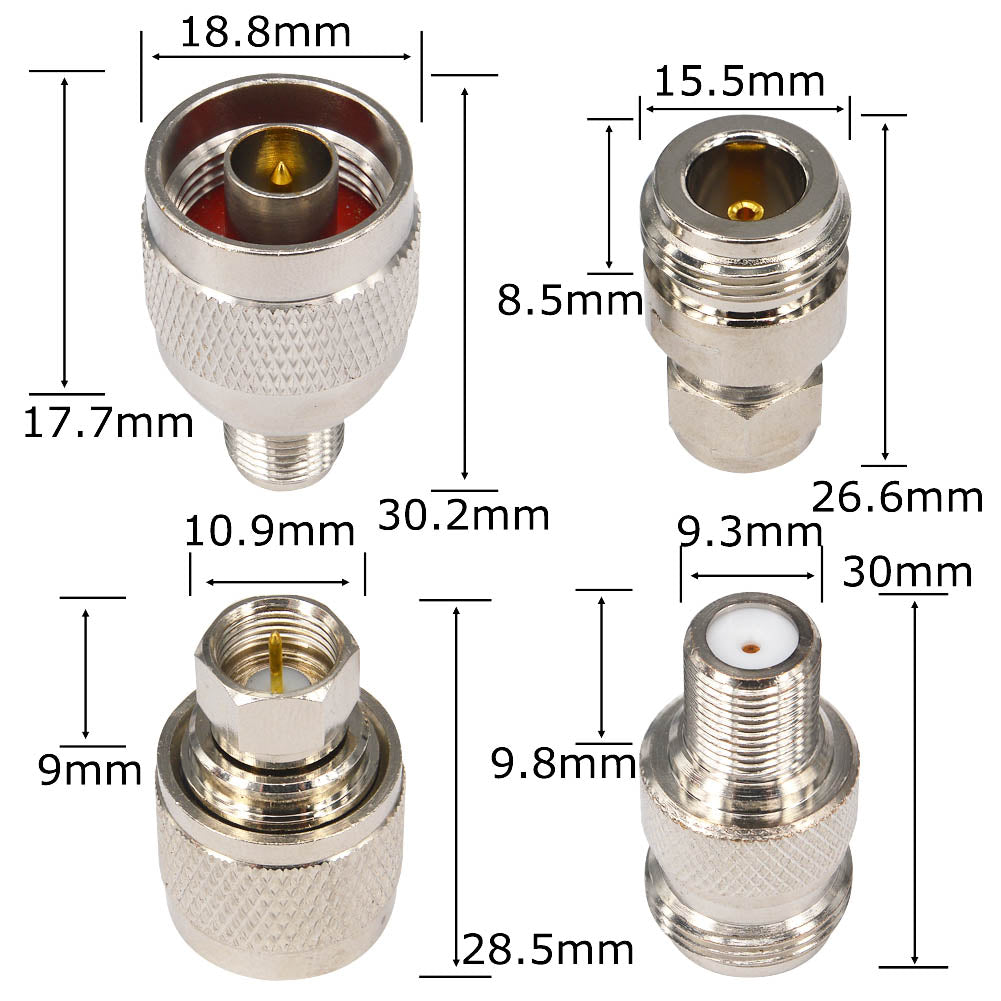
  1x N Male to F Female
  1x N Male to F Male
  1x N Female to F Female
  1x N Female to F Male
Frequency Range: DC to 3 GHz
Impedance: 50 Ohm
Body Material: Brass, Nickel Plated
Quantity: 4 adapters per kit
Price: $10.99
In Stock: Yes
Compatible With: WeBoost, Wilson, SureCall signal boosters; RTL-SDR, HackRF, Uniden scanners; home RG6 coaxial cable systems
---
This 4-piece kit covers every possible gender combination between N-type and F-type coaxial connectors — N Male to F Female, N Male to F Male, N Female to F Female, and N Female to F Male. The two primary use cases are cellular signal booster installation and SDR/scanner antenna connection. For signal booster use, WeBoost, Wilson, and SureCall boosters and their outdoor antennas use N-type connectors, while existing in-wall home coaxial cable runs terminate in F-type. This kit eliminates the need to run new cable — the appropriate adapter connects the booster directly to the existing RG6 infrastructure. For SDR use, RTL-SDR dongles and HackRF units use SMA (not in this kit) or occasionally N-type ports, while rooftop TV antennas and cable TV splitters use F-type. One adapter from this kit bridges that gap without additional cable.
All four adapters are machined from brass with nickel plating for corrosion resistance. The DC to 3 GHz frequency rating covers the full cellular signal booster band (700 MHz–2700 MHz), broadcast FM (88–108 MHz), VHF/UHF TV and scanner frequencies (50–900 MHz), and the lower cellular and WiFi bands. Nickel-plated brass provides significantly better mechanical durability and RF performance than zinc alloy or plastic-bodied adapters, which can crack under repeated connection cycles or corrode in humid environments.
Note on impedance mismatch: N-type is a 50 ohm connector standard, while F-type is nominally 75 ohm (used in cable TV and antenna systems). This adapter allows physical connection between the two systems, but there is an inherent impedance mismatch between 50 ohm N-type equipment and 75 ohm F-type cable. For short adapter connections (no cable between), the mismatch loss is typically under 0.5 dB and acceptable in most signal booster and SDR applications. For precision RF work requiring matched impedance, purpose-built 50-to-75 ohm impedance converters should be used instead.
Frequently Asked Questions
Yes. WeBoost outdoor donor antennas and indoor coverage antennas use N-type connectors. Most homes have existing RG6 coaxial cable runs that terminate in F-type connectors at wall plates and splitter outputs. The N Female to F Male adapter (included in this kit) connects the booster's N-female port to an F-male cable end, allowing the existing in-wall cable to carry the boosted signal without running new cable. The same approach works with Wilson and SureCall boosters, which also use N-type connectors on their antenna ports.
N-to-F connections can occur in four gender combinations depending on the specific ports on the devices being connected. A booster's N-female output port connecting to an F-male cable is different from a scanner's N-male port connecting to an F-female wall plate. Including all four combinations means you have the correct adapter regardless of which gender ports appear in your specific installation — eliminating the common problem of ordering one adapter only to find you needed the opposite gender.
There is a theoretical impedance mismatch between 50 ohm N-type and 75 ohm F-type systems. In a direct adapter connection (no cable between), this results in approximately 0.18 dB of reflection loss — negligible for signal booster and SDR applications. The loss becomes more significant if a long length of 75 ohm RG6 cable is used between 50 ohm equipment, as impedance mismatch accumulates along the cable. For most home signal booster and scanner installations, the practical impact is not measurable in improved reception.
Yes, with one clarification: most RTL-SDR dongles use an SMA female port, not an N-type port. To connect an RTL-SDR to a rooftop TV antenna (F-type), you would need an SMA-to-F adapter rather than this N-to-F kit. However, if your SDR receiver has an N-type port (such as some HackRF configurations or professional SDR units), the N Female to F Male adapter in this kit connects directly to the F-male end of the antenna cable.
These adapters are rated DC to 3 GHz. This covers all 4G LTE bands (700 MHz–2700 MHz) and sub-3 GHz 5G NR bands used by US carriers, including n71 (600 MHz), n25/n66 (1900/1700 MHz), and n41 (2500 MHz). It does not cover mmWave 5G (24–39 GHz), but mmWave 5G signals do not propagate through home coaxial cable systems in any case. For all practical residential signal booster applications, the 3 GHz rating is fully sufficient.
The nickel-plated brass body is corrosion-resistant and suitable for outdoor use. For permanent outdoor installations, wrap each adapter connection with self-amalgamating (self-fusing) tape after assembly to seal the threaded interface against moisture ingress. Unsealed outdoor connections can corrode over months in wet or coastal environments. The adapter itself will not fail from exposure, but the threaded interface between the adapter and cable or device connector is the vulnerable point.