


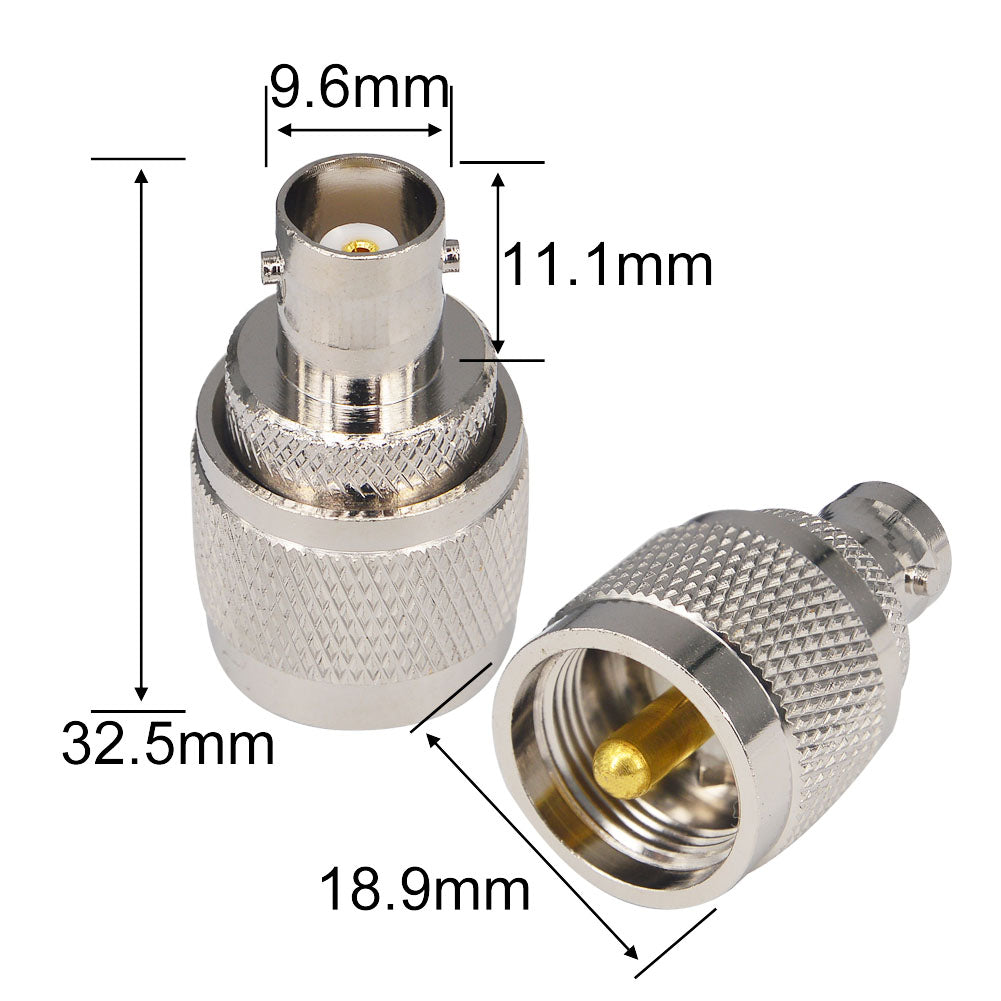
Product Details
--- QUICK SPEC REFERENCE ---
Product: BNC Female to UHF Male (PL-259) Adapter
SKU: OL0065-2X
Connector A: BNC Female (bayonet lock, center socket)
Connector B: UHF Male / PL-259 (external threads, center pin)
Body Material: Brass, Nickel Plated
Impedance: 50 Ohm
Applications: Ham radio antenna, SWR meter, CB radio, scanner, base station
Quantity: 2 adapters per pack
Price: $6.48
In Stock: Yes
---
This adapter converts a BNC female port into a UHF male (PL-259) connector, allowing BNC-terminated cables, test equipment, and signal generators to connect to SO-239 (UHF female) ports on CB radios, HF transceivers, SWR meters, antenna tuners, and base station antennas. The BNC female end accepts any BNC male plug via quarter-turn bayonet lock, while the PL-259 end threads directly into any SO-239 socket on radio equipment or antenna feedlines.
Typical use cases include connecting a BNC-port oscilloscope or spectrum analyzer to an SO-239-equipped SWR meter or dummy load for transmitter testing; adapting a BNC-terminated signal generator output to a CB or HF transceiver's SO-239 antenna port; connecting BNC-jacketed coaxial test cables to UHF antenna systems during alignment and troubleshooting; and cross-connecting BNC test bench equipment with UHF-standard ham radio infrastructure. The high-tension BNC bayonet mechanism provides a secure, vibration-resistant connection on the BNC side.
The UHF connector (PL-259/SO-239) does not maintain constant 50 ohm impedance above approximately 300 MHz. This adapter is therefore best suited for HF (1–30 MHz), CB (27 MHz), and lower VHF (30–150 MHz) applications. For UHF frequencies (300 MHz and above), N-type or SMA connectors provide better impedance control. For CB and HF ham radio work, the performance is fully adequate.
Frequently Asked Questions
The most common use is connecting BNC-terminated test equipment — oscilloscopes, signal generators, spectrum analyzers, or antenna analyzers — to SO-239-equipped ham radio or CB radio equipment. For example, connecting a BNC-output antenna analyzer (like the RigExpert or NanoVNA) to a PL-259-terminated antenna feedline for impedance measurement, or connecting a BNC oscilloscope probe to a CB transmitter's SO-239 antenna port for RF output waveform observation.
Yes. Most CB radios have SO-239 (UHF female) antenna ports. This adapter's PL-259 end threads into the SO-239 port, and the BNC female end accepts a BNC male cable connector. This allows you to use BNC-terminated coaxial patch cables or test equipment with CB radio equipment without re-terminating the cables with PL-259 connectors.
Standard BNC connectors use a spring-loaded bayonet locking mechanism that engages with a quarter-turn rotation. "High-tension" refers to the spring force in the bayonet lock — a higher spring tension means the connector is harder to accidentally disconnect under vibration or cable pull. For mobile radio and field use where cables are subject to movement, a higher-tension BNC bayonet provides more reliable retention than a loose-fitting lower-tension BNC connection.
Yes. Most SWR meters for CB and amateur radio have SO-239 (UHF female) ports on both the transmitter side and antenna side. This adapter's PL-259 end connects to either port, allowing BNC-terminated cables or equipment to interface with the SWR meter. For connecting an antenna analyzer with a BNC output to an SO-239-equipped SWR meter or antenna feedline, this is the correct adapter.
PL-259 to SO-239 connections use a coarse thread (about 5/8-24 UNS) that is relatively forgiving of misalignment compared to fine-threaded connectors like SMA or N-type. However, cross-threading is possible if the connector is started at an angle. Always start the thread by hand, rotating counterclockwise until you feel a slight click (the thread seating), then rotate clockwise to tighten. Never force the thread — if resistance is felt before normal engagement, back off and re-seat.
Test bench setups frequently require the same adapter at multiple connection points simultaneously — for example, connecting both an input and output of a bandpass filter to BNC test cables while the filter's ports use SO-239 connectors. A spare adapter also ensures test bench continuity when one adapter is in use elsewhere or if a bayonet lock shows wear after extended use.